

Here's a California Classic from Napa's premiere Biodynamic winemaker.

Showing posts with label California. Show all posts
Showing posts with label California. Show all posts
March 08, 2012


March 01, 2012
Ridge 2008 Zinfandel Lytton Springs
One of the wonderful estate Zinfandels from Ridge, one the truly iconic California wineries with a long and storied history.
February 15, 2012
Bargain Basement Bonus: Jeriko Estates 2009 Syrah
Here's a bonus episode for ya: A nice organic bargain Mendocino Syrah ($9.99) for everyday drinking.
February 09, 2012
Alma Rosa 2009 Chardonnay Santa Barbara County
A fabulous little Chardonnay from one of my favorite producers on the Central Coast. This is what California Chardonnay should be all about.
Alma Rosa's Santa Rita Hills tasting room taken on my Summer 2010 Central Coast trip.


Remember this guy from Sideways? That's Chris Burroughs, and he is indeed the tasting room manager at Alma Rosa.

January 26, 2012
Natural Wine Wars: Old v. New World Albariño
An Albariño from Rias Baixas, the traditional home of this wonderful Spanish variety goes up against a sustainably produced California Central Coast version.
January 25, 2012
AmByth Estate

 As I did my research for information I could pass on to you my fellow natural wine lovers, I came across a very informative article that nicely summarizes of AmByth Estates is all about, with much more in-depth information that I had access to. So with your indulgence I will re-post that article here for your reading enjoyment.
But first a few other highlights about AmByth that get me excited.
1. Climate-appropriate varietals including Mourvedre, Grenache, Syrah, Counoise, Tempranillo, Sangiovese, Roussanne, Marsanne, Viognier, & Grenache Blanc
2. No fining or filtering
3. Several wines with NO added sulfites
4. Low alcohol - none over 13.5% (unusual for Paso Robles)
5. Indigenous yeasts only as required by Biodynamic wine making practices
6. Whole cluster fermentation, stems and all
7. Real involvement in the work of the vineyard - no outside labor for harvest
8. Stay-small philosophy
9. A great blog that lets you follow AmByth's activities throughout the year
10. A great welsh name that means 'forever' and bespeaks the enduring ties the owners feel towards their property and chosen life, as well as their land in a state of health for future generations

Ambyth Wine Estate: Nuts For Natural Wine
Josh Petray
(Re-posted from VinoPasoRobles.com Fall 2011)
Ambyth Wine Estate crafts fine biodynamic wines out of Templeton Gap
Biodynamic pioneers Mary and Phillip Hart’s Templeton hilltop estate originally planted with vineyards in 2004 has become more of a farm. For the owners, it’s a lifestyle choice. And a healthy one at that, they said.
The Harts, owners of Paso Robles American Viticultural Area’s only certified biodynamic/organic vineyard and winery, say they never undertook the niche certification for the money or the marketing boost it would provide in a culture arguably intrigued with sustainable buzzwords like biodynamic and organic, but their wines happen to be both.
Witnessing the growth of the vines and evolution of farming practices on their estate — situated in the Templeton Gap and cooled by Pacific coastal breezes — is part of what characterizes the “new ancient,” as Phillip coined it, for Ambyth Estate Wines.
“Huge,” Phillip said as he stood perched looking at the two cows mowing weeds on the estate vines in response to the question: How has the growth been on the vineyard since it was planted?
The vines — stronger. Grape clusters — more organized. From a wine-growing perspective, advancement as one could hope, according to Phillip.
Sixty-five apple and pear trees, more than 60 fruit and nut trees and eight beehives adorn the property. Chickens bear eggs that the family eats. Two sheep that roamed the property, fertilizing it, are now in the freezer, awaiting an epicurean twist. Rabbits are reared for weed-eating and eventual consumption.
“We’re not just a vineyard,” he said. “We have become much more of a farm.”
The couple’s love of the land is visible at every step of the way at Ambyth Estate. Olive-oil lovers have been known to make the trek all the way to Ambyth to pick up what Phillip described as fine an olive oil as one can get. Five-hundred-and-forty olive trees adorn the property, producing a two-and-a-half-ton harvest last year.
In addition to the dry-farmed olives, the Harts make their own honey from beehives situated throughout the Templeton property.
“That was outstanding — just to have our own extra virgin olive oil,” Phillip said. “In my opinion, it’s as fine of an olive oil as you can find on this planet. It is purchased by people just the same as honey — it’s just good stuff. Here, right out of the winery.”
He’s quick to point out that whole farming/biodynamic component wasn’t necessarily in the couple’s master plan. It was just “the path that just keeps opening up.”
“When I think by being biodynamic, the path has opened up more because it does tend to make you read more to understand what you’re doing,” he said.
What follows is a learn-and-dothrough- reading approach that’s allowed him to see what others have done successfully on their properties, and then emulate it.
“There’s a gas that apples give off that’s great for all other growing plants,” he said, offering up a theoretical example. “You go, ‘Ooh, I have a west fence that the breeze comes through every day — that would be a great idea.’ That kind of stuff. Really, that’s how it happens.”
“It was never a marketing plan,” he said. “It was a choice of a way of life, but there seems to be a nice peripheral sides that go with that.”
In fact, the proprietor and Persian rug aficionado said he’s not heavy on the whole certification side of things. Although Ambyth carries the heavy organic and biodynamic certifications, it blends in nicely with the natural approach already being undertaken at the farm.
Despite any preconceptions about the mysticism steeped in biodynamic farming, Hart professes that biodynamic pioneer Rudolf Steiner “is no guru,” nor a “prophet,” simply someone who took information from the past and spoke about it in a way that people could understand intellectually and move forward.
“It’s not a mystical way of farming — it’s actually an old-fashioned way of farming,” he said.
The “natural way” of farming biodynamically appeals to Mary, too.
“It’s a safe environment that we’ve created here on our property, not only for our family but for our animals, any beneficial predators or insects that we have. Visitors, if people come and eat at my table they’re going to get food that is healthy and clean for their bodies, and wine as well,” she said.
At Ambyth, Phillip handles the vineyard and winery. Mary takes charge of the gardens, fruit and nut trees, small animals.
“We’re trying to create a closed system,” Mary said. “Things just keep going — it’s circular.”
That’s not to say that biodynamism isn’t something that’s misunderstood by the vast majority of farmers and wine enthusiasts.
“Some people are wide open to it, and of course as with everything else in life, other people are absolutely closed shut, and that’s fine, I don’t have a problem with it,” Hart said.
According to the Biodynamic Farming and Gardening Association, the movement laid its roots in the 1920s with a group of practicing farmers who were concerned with the decline in the health of soils, plants and animals, and sought the advice of Steiner, founder of anthroposophy. The movement embraces a “unified approach to agriculture that relates the ecology of the farm-organism to that of the entire cosmos,” according to the group.
It’s an approach, from the preps to the harvest that the Harts believe in. From planting the vines to making the wines, all facets of winemaking occur onsite at their estate.
Among natural approaches, the Harts do not fine or filter and use only native yeasts. Lower alcohol level wines are sought after.
“Take a look at the property,” Phillip said, offering evidence of the success of biodynamism. “Look at the vines.”
Wines harvested from Ambyth vines are oftentimes described as “interesting,” said Phillip. That — and they’re “very pleasing.”
“I typically hear that they’re all different,” he said. “I think that’s what you get when you go this way. The question of do I really believe in it? Well, it’s self-evident.”
Just this year, the couple purchased quartz from an exclusive New York distributor to be buried in the vineyard, among other prep work undertaken.
Varietals grown on the property include grenache, grenache blanc, mourvedre, syrah, viognier, Rousanne and Cuonoise.
Last year’s vineyard crop was good, in part due to the rain, according to Phillip. This year, the couple has decided to take a step back and sell about half the fruit in order to take a breath and tend to some of the other things around the farm.
Hart comfortably described the zero growth statistic in sales for Ambyth wines in 2010 from the year prior, which he described as “pathetic,” and “a horrible year business-wise.”
“You should have growth in those early years,” he said, adding, “This year we’re on target for where I thought we were last.”
People do travel the beaten path to seek out Ambyth, the couple said. For Mary and Phillip, it’s always kind of fun to see visitors seek out their estate-grown wines, from places near and far. They’ve grown to learn just how many natural wine enthusiasts there are out there. Though limited (and admittedly not providing an exciting business climate due to its limited range), they’re a dedicated bunch that will single Ambyth out for a taste of something distinct and different.
“I didn’t quite realize how many biodynamic wine nuts there were out there,” Phillip said. “Natural wine nuts — and I say that in a friendly way because I’m a natural wine nut.”

December 29, 2011
December 01, 2011
Bonny Doon 2006 Le Cigare Volant
One of The Grapes of Rand's early producer profiles featured Bonny Doon Vienyard. The article was entitled Of Flying Cigars and Terroirs, a reference to Bonny Doon's homage to Chateauneuf-du-Pape, Le Cigare Volant. Today I taste the 2006 vintage of Le Cigare Volant, a wine that was awarded 91 points by Stephen Tanzer. Watch the video to find out how I scored the 22nd vintage of this iconic Central Coast Rhone blend.
November 30, 2011
Grgich Hills Estate


KEY DIFFERENCES BETWEEN NOP ORGANIC* AND DEMETER BIODYNAMIC®
History
-National Organic Program (NOP) established in US in 2002
-Demeter established in Europe in 1928, and in the US in 1985
Use of imported materials
-NOP permits imported organic fertilizers and pesticides
-Biodynamic reduces imported materials by addressing its needs from within the farming system
Fertility delivered via a nutrient rich soil component, called humus, created by the:
-Integration of livestock
-Intensive use of green manure (cover crops grown to add nutrients to soil) and legumes
-Rotation of crops
-Application of field/compost sprays
Pest and Disease Control
-Creation of biologically diverse habitat encourages balanced predator prey relationships
-Humus development contributes to insect and disease resistance
Water:
-Increased humus levels result in soil’s ability to store water
-Preservation of riparian areas emphasized
Livestock feed source
-NOP allows for organic feed imported to the farm from anywhere in the world
-Biodynamic requires 80% of livestock feed be grown on farm.
Biodiversity requirements
-No specific NOP requirement
-Biodynamic requires a biodiversity set- aside of ten percent of the total farm acreage
Farm certification
-NOP is crop focused and allows for a designated parcel to be certified
-Biodynamic is farm focused and requires that the whole farm be certified
Product certification
-NOP processing standard is applied across product types and focuses primarily on ingredients used
-12 Biodynamic processing standards, developed for specific product types, require minimal manipulation so that the
agricultural ingredients used define the product
I don't know if it is that Biodynamic producers just develop an intuitive trust in the power of the sun because of the wonderful results they see it produce in their fruit, but Grgich Hills Estate, like many other Biodynamic producers, has taken its earth-friendly production practices outside of the vineyard, using the sun's energy to supply almost 100% of its electrical needs. 860 photovoltaic panels covering the winery's red tile roof provide a renewable, pollutant-free energy source in line with Gergich's overall philosophy of sustainablility.
 Seeing wine producers do everything in their power to produce wines in a natural, sustainable, earth-friendly way is always encouraging. But in the end the quality of the wine must, of course, be the ultimate measure of success. Judging by the many accolades Grgich Hills Estate wines have garnered over the years, and continue to garner today, I would say they are doing a pretty good job of measuring up. Below are just a few of the high scores and other honors some of Grgich's wines have collected for their recent vintages:
2007, 2008 Chardonnay - Stephen Tanzer 90 points
2007 Chardonnay served at the White House executive residence
2007 Carneros Selection Chardonnay - Tasting Panel 94 points
2008 Zinfandel - Wine & Spirits 91 points
2005 Miljenko's Old Vine Zinfandel - Wine News (wine of the year) 95 points
2007 Cabernet Sauvignon - Michael Apstein 96 points
2006, 2007 Cabernet Sauvignon - Robert Whitley 96 points
2004 Cabernet Sauvignon, Yountville Selection - Wine News 94 points
2005 Cabernet Sauvignon, Napa Valley - Wine Spectator 92 points
2008 Violetta late harvest - Wine Spectator 90 points
Grgich Hills Estate (link)
* Some information about the movie Bottle Shock was sourced from WineCountry.com.
November 18, 2011
Thanksgiving Dinner Wine Pairings
Hello my fellow wine-lovers. Today we are getting you ready for your Thanksgiving dinner celebration with two lovely wines. We will be tasting The Eyrie Vineyards 2009 Pinot Noir, and to pair with your Thanksgiving desserts, a wonderful late harvest Riesling from Napa Valley's Frog's Leap Vineyards.
November 10, 2011
Natural Wine Wars: Mendocino Cabs
Two value priced Mendocino Cabs, each coming in at about $17.00 do battle in our first ever installment of Natural Wine Wars. Today I pit the certified Organic 2009 Bonterra Cabernet Sauvignon against the Demeter Biodynamic certified 2006 Jeriko Estate Cabernet Sauvignon. To make it more interesting, I will taste them blind. Watch to find out which wine wins the battle.
November 07, 2011
Summer 2010 Tour of Clos Pepe


October 20, 2011
Frog's Leap 2010 Sauvignon Blanc
From one of Napa's premiere organic producers: Nice example of a California Style Sauvignon Blanc with loads of classic character.
October 12, 2011
Frog's Leap - "Time's Fun When You're Having Flies"

Where am I going with this jabber anyway? Oh yeah, web-sites! Fun, interactive web-sites. Web-sites that keep me entertained while they inform. Web sites that have the feel of a board game, that let me do fun stuff to get my info. So, when I run across a winery's web site that has that kind of feel, I get really excited. If you read my Bonny Doon Vineyards profile Of Flying Cigars and Terroirs back in August, you already know that I got pretty excited about their fun little site. I really didn't think another winery could top what Randall Graham and his creative team put together, but I think I have finally found a web-site that comes close, if not equals it. In fact, as was doing my research for today's producer profile of Frog's Leap Winery in Napa Valley, I was so captivated by their clever web-site, that I have decided to simply post their link here, so you can have some fun while you learn. So just do the clickedy-click below and find out more about this wonderful, organic, and eco-friendly Napa Valley producer and their wines. For quick reference I have also posted a few highlights and informative videos. Enjoy!
Frog's Leap Winery (Link)

- Company Motto - "Time's Fun When You're Having Flies"
- Location: Napa Valley, Rutherford appellation
- 40 Acres organically grown estate vineyards. Frog's Leap owns an additional 88 acres and farms another 100 acres in Rutherford.
- Organic pracitices emphasize health of soil and traditional farming methods including use of cover crops, complementary crops, and dry-farming.
- Winemaker - John Williams - Masters in Viticulture and Enology UC Davis
- The name Frog's Leap inspired by John's first wine-making gig at Stag's Leap
- Annual production: 60,000 cases
- Wines:
- Cabernet Sauvignon
- Chardonnay
- Merlot
- Sauvignon Blanc
- Zinfandel
- Rutherford (Cab Sauvignon/Cab Franc blend)
- Petite Syrah
- Pink (Zinfandel/Valdiquie blend)
- Frogenbeerenauslese (Late Harvest Riesling)
- Wine-making philosophy: Minimal handling, terroir-driven. Use of Natural Yeasts.

- Committed to Sustainability
- LEED Certified
- 100% Photovoltaic and Geo-thermal energy
- Dry Farming
- Ratings:
- 2010 Sauvignon Blanc (93) Wine & Spirits
- 2007 Napa Valley Cabernet Sauvignon (94) Wine & Spirits
- 2008 Napa Valley Cabernet Sauvignon (92 ) Wine & Spirits
- 2007 Rutherford Cabernet Sauvignon (91) Wine Enthusiast
- 2008 Zinfandel (91) Wine Enthusiast
Frog's Leap Vids:
August 31, 2011
Paul Dolan

Hmmm...Moon phase is a waxing crescent. I wonder what that portends for my activities tonight? I think I'll consult a biodynamic calendar. Now, where did I last see my biodynamic calendar? Can't...seem...to...find...it...anywhere. Oh well, best log on to Paul Dolan Vineyards web-site. Ah, here it is: Fruit day, and, oh what luck...a favorable day to taste wine!
Well, I just happen to have a bottle of Parducci 2009 Pinot Noir (coincidentally enough produced by one of Paul Dolan's labels) right here. Who's to argue with the Bilodynamic calendar? Ah, not bad. A surprisingly delicate Pinot Noir-like character. Nice red fruit with a hint of vanilla and smoke. Not bad for a $14.00 bottle of Pinot Noir. But then, I have rarely been disappointed by any of the modestly priced, sustainably produced Parducci wines.
 Since we are on the subject I might as well tell you all a little about Paul Dolan, the mastermind behind the Parducci empire. Super green and sustainably produced Parducci wines are just one child in Dolan's corporate family. But before I introduce the rest of the clan, let me back up a little. Paul Dolan grew up with wine in his blood with Rossi and Concannon family connections. It was, in fact, his winemaker uncle Ed Rossi who in the early 70's inspired Dolan to write a paper on the wine industry as part of his college business and finance curriculum. This look back into his family legacy was enough to cement Dolan's move towards winemaking and in 1975 he enrolled in the Enology program at Cal State University, Fresno. From there he went on to make wine for Fetzer, where he worked for 27 years, including 12 as president. With Dolan at the helm Fetzer became a leader in organic viticulture and sustainable business practices; two principles that continue to be central in all of Dolan's ventures.
His commitment to not only grow grapes and make wines sustainably, but to run his business sustainably is one thing I love about Paul Dolan. The man is firmly committed to a holistic business concept which has as a central tenet that the progress and wealth business creates will still be there for future generations. Dolan believes that in such a business model economic profit cannot be the only measure of success. To codify this concept he has initiated his e3 action plan which is shorthand for a "tripple bottom line," consisting of economics, environment, and social equity. Here are Dolan's views on sustainable business summed up in his own words:
A sustainable business should be a whole business, like a whole person. It must have integrity. It must have a moral center. It must be connected to its values and the greater world. It must aspire to do what is right, not just for the bottom line, not just from a legal standpoint, but from a moral and ethical standpoint. It’s not only accountable, it’s responsible.
When winemakers are serious about this kind of a holistic business philosophy underlying their work in the vineyard and winery, it inspires confidence in me that their aim in choosing sustainable paractices is more than just a fashion statement, and truly part of a commitment to produce the best wine possible.
In 2004 Dolan Partnered with like-minded Tim and Tom Thornhill to form the Mendocino Wine Company, parent to their current range of brands headed by Parducci, their original 2004 acquisition. Under Dolan and the Thornhills Parducci has come to represent the pinnacle of sustainable practice, priding itself on being the first carbon neutral winery. The winery relies 100% on green power in including solar energy. There is also a huge emphasis on water conservancy and wetlands conservation, as well as earth friendly packaging.
 This firm commitment to sustainability also carries over to the grapes which are grown in the estate's own 100% organically certified vineyards, as well as sourced from locally owned family farms. All partner vineyards are also certified either Biodynamic, Organic, or Fish Friendly. In the vineyards there is no use of chemical soil amendments, weed control, or pesticides. This includes the use of wildlife corridors which encourage natural predators, and bug farms to attract beneficial insects. Cover crops are grown between vines to enrich the vineyard and prevent erosion. Dolan's practices in general avoid any practices which harm the environment or deplete the soil, including bioengeneering, ionizing radiation, or GMOs.

I have to confess, I haven't had too many opportunities to enjoy Paul Dolan's wines outside of the Parducci label. I do have quite a favorable impression though of the Paul Dolan Vineyards Chardonnay which I tasted last summer, if memory serves me right. Which, of course, means that I have some tasting homework ahead of me. Alas, what a grueling responsibility!
I hope you have found reading about Paul Dolan as interesting as I have researching and writing about him. Now go out and taste his wines and let us know what you think by posting a comment. That little window at the bottom of the page is all yours for bearing your wine-loving soul...so go for it!
Starting Friday, and over the next 10 days I will be posting a series of short one to two minute videos which feature Paul Dolan outlinging the basic concpets of Biodynamics. Very interesting and concise primer on Biodynamics. So come back and check it out!
August 25, 2011
Bonny Doon 2009 Ca' del Solo Muscat
Nice wine from Bonny Doon, ideal for sipping on the back porch on a warm summer evening with good friends and spicy asian dishes.
August 19, 2011
Of Flying Cigars and Terroirs

Without a doubt one of my favorite weird events in the history of wine has to be the 1954 passage by the village council of Chateauneuf-du-Pape of a law prohibiting the landing of flying saucers or as the french called them, cigare volant (flying cigar), on vineyard land. This unusual law was evidently a reaction to the perfectly reasonable worry that flying saucers would damage the precious fruit of the vine, were they to touch down in the vineyards. The prudence and foresight of this dictate is obvious when one considers that to date not one flying cigar landing has been reported anywhere in or near Chateauneuf-du-Pape, no doubt due to the stringent pentalty that any offending spacecraft will be immediately impounded!
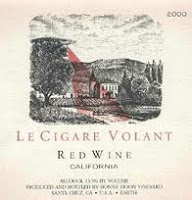 Amusing as this story is, I find it quite fitting that the flagship wine made by one of the most idiosyncratic men in all of Winedom is named Cigare Volant in homage to this possibly strangest of all wine stories. The ironically traditional label depicts a hovering spacecraft deploying it's death-ray, an eventuality I don't believe the Village council ever considered. This label and the highly regarded Rhone blend behind it are two of the many, many brainchildren of übercreative and überdriven Randall Graham, self-proclaimed president for life of Bonny Doon Vineyards.
 Graham's compelling story meanders through over three eventful decades only to end exactly where it began in 1979, with a quest to create something of "original beauty," and not just a copy of an idealized form. In the beginning the mission was to create the perfect Pinot Noir, one that would be an expression of it's unique terroir rather than another poor attempt to re-create Burgundy in California. To this end Graham, with the help of his parents, purchased property in an area known as Bonny Doon in the Santa Cruz mountains and an epic wine journey began. Only, it wasn't Pinot Noir, but until then untried Rhone varietals that proved successful in the newly established vineyards. The ever adaptable Graham saw an opportunity and ran with it, cementing his place in California wine history as one of the original Rhone rangers.
In the late 1980's, not satisfied with having lit a fire under California's ampelographical evolution with Rhone grapes, the ever restless Rhone Derranger, as Graham is wont to call himeself, began planting a bevy of Italian varieties inluding nebbiolo, barbera, dolcetto, freisa, and pinot grigi in his Ca' del Solo vineyards in Monterrey County. All this still driven by a quest to match grape to it's ideal terroir.
Over the next decade the Bonny Doon kingdom grew into what many, most significantly some influential wine critics saw as an increasingly unwieldy empire, including such value mega-brands as Big House, Pacific Rim, and Cardinal Zin. It wasn't only Graham's innovative and experimental nature that led to Bonny Doon's incredible success, but an uncanny bent for unconventional, sometimes irreverent marketing, featuring often witty, sometimes sarcastic, always unique label art.
 Not far into the current millennium the ever ready to evolve Randall Graham decided once again that it was time to move on towards better things. In this case, however, better was not bigger, but smaller...much smaller. The self-styled Taoist winemaker was ready to take a radical new turn in his "spiritual Journey," and so divested himself of his successful mega-brands including Big House and Cardinal Zin, spun off the Pacific Rim brand. This change meant a significant drop in production from over 400,000 to 35,000 cases. For Graham this latest incantation of Bonny Doon meant a re-focusing on his spiritual winemaking roots: a quest for wines that expressed a unique sense of place. It is evident that Graham sees these exhaustive changes less as a radical shift away from, but a distilling down of knowledge and experience gained along an indispensable journey, evidenced by his continued employment of technical innovations such as microoxygenation, cryoextraction, and his almost fanatical faith in screw-caps, to accompany his passionate shift towards back to nature vineyard practices such as biodynamics and dry farming.
What the future holds for Bonny Doon is anyone's guess, but it will no doubt be compelling. For the time being Graham continues his quest to create true wines of place by producing terroir-driven estate wines, a variety of traditional Rhone style wines, including the flagship Cigare Volant, and Italian varietal wines produced from his Ca' del Solo vineyards. The good news is that Graham's journey is not hard to follow as this most open and engaging of vignerons is anything but secretive about his activites. He candidly journals his experimentations on his website www.beendoonsolong.com, putting his characteristic cerebral humor and wisdom on display for all wine lovers to enjoy. The title of this informative website is also the title of his newly published autobiographical book Been Doon So Long, which you can find linked in the Literary Elucidations section of this blog. Graham has also created one of the most entertaining web-sites for Bonny Doon Vineyards that has much more the interactive feel of an artsy board game than the informational site that it is. I have found it quite entertaining, and have included the link for all you wine lovers out there, so you too can play: www.bonnydoonvineyard.com.
August 08, 2011
Beckmen Vineyards

 Stick around long enough, and you will quickly catch on to my love-affair with California's central coast wine country. In the summer of 2007 I got in my car and drove due west 800 miles on a whim one day just to clear my head. Where I would end up was anyone's guess. Driving north along the coast from Santa Barbara towards Morro Bay, my intended destination for the night, I was inexplicably gripped by an urge to veer off PCH just past Goleta, and to head towards the oddly situated somewhat Disneyesque "Danish" village of Solvang. I arrived in Solvang before dark, just early enough to wander the surreal cobblestone streets past endless rows of half-timbered gingerbreadish souvenir and pastry shops. As weirdly captivating as I found this most kitschy of all California towns, I knew the next morning would find me rolling on to follow the myriad of intriguing little white arrows with vineyardy sounding names stenciled on them, pointing down winding two-lane highways.
As soon as I had driven past the last pseudo-Scandinavian motel, I know this would be one of those rare life-changing drives in the country. Past white-fenced farms, eucalyptus-lined horse pastures, orchards, and small vineyards, and on into the rolling Santa Maria hills vineyards along the heart-stoppingly beautiful Foxen Road.
 This was the kind of scenery that makes you glad to be alive, to find a new purpose, and to want to figure out how to put down roots immediately, right then and there. At the very least, it was the kind of place that makes you decide that come hell or high water you will be back, and back I came. Four months later my brother and I rolled back up the pacific coast highway for a spectacular week of camping on remote beaches, gallery hopping, sight-seeing, and some incredible eye-opening wine tasting in and around the ruggedly scenic, sage infused Santa Ynez Valley. The wines we tasted on this trip were principally from the warmer valley floor vineyards, and Santa Maria hills, mostly delicious, delicately fruity Rhone varietals and luscious tropically scented Sauvignon Blanc.
It wasn't long, two years to be exact, before I returned with my girlfriend at the time for a second round of sampling the produce of the central coast vineyards, discovering the fabulously alluring Pinot Noirs and bright, delicate Chardonnays of the Santa Rita Hills. But these wines are material for another day.

Today we will take a look at Beckmen Vineyards, a producer named Food & Wine's "Most Promising Winery in 2000," and in 2007 as one of he "Top 100 Wineries" by Wine and Spirits magazine.
When I first visited Beckmen in 2007, they were just a year into the process of converting to all Biodynamic farming methods in their spectacular 365 acre Purisima Mountain Vineyard, and therefore the wines I tasted had not yet benefited from the meticulous and intensive procedures that have presumably influenced their current crop of wines. I must confess I have not tasted Beckmen's wines recently, but they are definitely on the agenda for an upcoming video episode. For Tom and Steve Beckmen, proprietors since the early 1990's, biodynamics is more than anything else a reflection of their commitment to the highest quality possible. What impresses me is that their commitment to Biodynamics was not a knee-jerk image-making ploy, but was instituted only after careful small-scale testing before implementation throughout the vineyard.
According to Steve Beckmen, the results have been quite impressive, with healthier vines that have produced wines which "achieve the purest possible expression of the Purisima Mountain terroir." Steve feels that they are now producing their best wines ever, and I am looking forward to proving him right.

Subscribe to:
Posts (Atom)